CAS IN CORPORATE STRATEGY

The demands on managers are constantly changing – new markets, technological developments and growing international competition require the ability to critically reflect on challenges and successes and to act with strategic foresight. Leading companies successfully and with an eye to the future requires a comprehensive and in-depth understanding of complex external and internal relationships, strategic thinking and sound decision-making.

With the “CAS Corporate Strategy and Governance”, we offer you a high-quality, practice-oriented continuing education programme that deepens entrepreneurial aspects and professionalizes strategic thinking and action. The program is aimed at decision-makers who not only understand why companies are successful on the basis of existing competitive advantages – but also want to shape the future in a reflective and proactive manner.

You will benefit from an innovative programme concept, up-to-date content on strategy, internationalization and governance as well as a direct exchange of experience with proven experts from science and practice – with direct benefits for your entrepreneurial activities.
EMBA

Credit towards the “Executive Master of Business Administration in Strategic Management” at the University of Bern. This CAS can be combined with the CAS “Entrepreneurial Leadership” and another CAS of your choice to create an “Executive Master in Business Administration, EMBA”.

OUR OFFER

  • Dual approach: Personalities from science
    and practice teach in a team
  • Opportunity to work on your entrepreneurial
    problem
    during the course
  • Direct cooperation with personalities
    from science and practice
  • Support in the development
    and strengthening of individual and social skills
HAVE WE AROUSED YOUR INTEREST?

TARGET GROUP

Our CAS continuing education course “Corporate Strategy and Governance” is aimed at managers:

  • of business units that aspire to positions at company level.
  • in functional areas that want to develop in the direction of strategic leadership.
  • in administrative and supervisory boards who want to better understand and practice strategy-relevant content and processes.
  • who have professional experience in operational areas and want to supplement, deepen or update their specialist and management knowledge in the area of strategic management to meet their needs.

BROCHURE

Take a look at our brochure. You’ll find all the information you need at a glance!

Titelseite

INSIGHTS INTO FURTHER EDUCATION

INFORMATION MEETINGS

Have we aroused your interest? We would be happy to welcome you for an individual discussion, inform you personally about the CAS in Corporate Strategy and answer any questions you may have.

REGISTRATION INFORMATION MEETING

COURSES & LOCATION

The course takes place at the University and in the Kursaal Bern. The study times on the course days are from 08:15 to 17:30. The evening programs take place after the lessons and last until 22:30 at the latest. Lessons are taught in German.

The Entrepreneurship Center course is completed with a “Certificate of Advanced Studies in Corporate Strategy, University of Bern” and comprises 15 ECTS. Active participation and preparation for the modules account for 12 ECTS. 3 ECTS are awarded for the certificate thesis.

MODULES & DATA

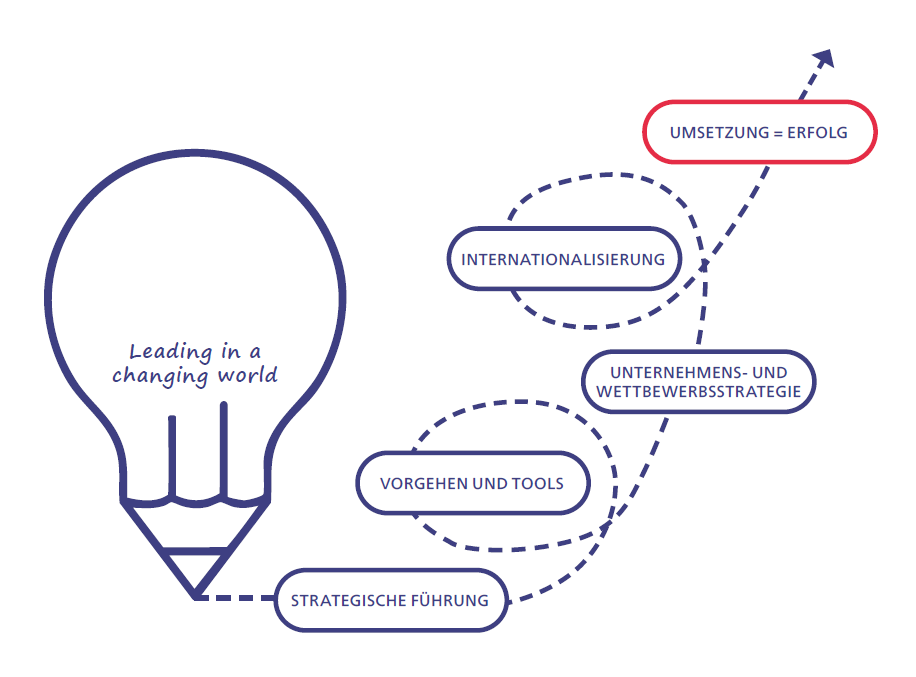
In modules that build on each other, you will learn the essential contents of the described development process – from brainstorming to implementation – and apply essential tools.

Module 1 / October 30 - November 01, 2025

FUNDAMENTALS OF STRATEGIC MANAGEMENT

The basic module provides specific content for an in-depth understanding of global economic interrelationships and economically relevant entrepreneurial aspects. As a result, participants acquire knowledge and skills in areas such as resource analysis and decision-making competence. In particular, they learn the fundamental qualitative and quantitative skills that form the basis of successful business management.

In Module 1, participants also acquire basic knowledge of the economic environment. They learn how key macroeconomic indicators – such as the inflation rate, interest rates, GDP growth and the unemployment rate – are interrelated. These relationships are explained and discussed in the context of economic policy measures.

Strategic thinking and action are no longer the sole responsibility of top management. Managers at other levels are also increasingly required to make strategic decisions competently and effectively. A sound knowledge of finance and accounting is essential for this. In this module, participants acquire the necessary financial know-how. One focus is on the fundamentals of financial management – including company valuation. You will learn how value is created in various business areas, how it can be measured and what value individual business units have, for example in the context of mergers and acquisitions (M&A).

Module 2 / December 04 - 06, 2025

CORPORATE STRATEGY – WHERE DO WE WANT TO BE ACTIVE?

Module 2 forms the integrative element of the program and provides a comprehensive entrepreneurial perspective. Participants deal with key aspects of corporate management in a cross-functional, internationally oriented and practical way. The focus is on the key strategic question: In which markets and with which products should a company position itself in order to be successful in the long term?

The content ranges from the definition and analysis of strategic business units to portfolio considerations and the development of strategic options such as diversification or focusing. The role of corporate headquarters is also examined, particularly with regard to its potential added value and possible management approaches in the interaction between headquarters and decentralized units.

A particular focus is on the systematic development of an overall strategy as part of a multi-part process. This begins with an introduction to suitable procedures and tools and continues with step-by-step group work on a case study through to the presentation of the solutions developed.

Module 3 / January 15 - 17, 2026

COMPETITIVE STRATEGY – HOW DO WE ACT?

Module 3 teaches key skills for answering the
question: How does a company operate successfully in a competitive environment? Participants learn how to obtain and analyze information relevant to competition in a targeted manner and use this information to make strategically sound decisions. The aim is to strengthen their own market position in the long term and systematically exploit competitive advantages.

One focus is on the analysis of industry structures, the importance of resources and skills as well as the development of sustainable competitive strategies – especially in dynamic, technology-driven markets. New business opportunities and future areas of competition are also taken into consideration. Technological developments and their impact on existing business models, particularly in high-tech industries, play a role, as do the opportunities offered by international markets for strategic positioning, particularly in the Swiss corporate context.

The module includes the Lantal case study, which is used to deepen the strategic analysis of real market and competitive conditions in a practical way. Other topics include strategic pricing – including digital pricing models – and the question of how pricing, corporate goals and customer benefits can be harmonized. The module also sheds light on strategic innovation activities – understood as the management of innovations from the perspective of top management, in particular with the management and prioritization of innovation portfolios.

Module 4 / March 12 - 14, 2026

INTERNATIONALIZATION AND ORGANIZATIONAL DESIGN

Module 4 is dedicated to the practical implementation of strategic concepts – a central but often neglected and underestimated aspect of corporate management. Strategy not only means defining long-term goals and planning suitable measures, but also implementing them effectively. Participants deal with specific challenges and success factors of strategy implementation and reflect on how strategic projects can be successfully implemented in different contexts. A special focus is placed on the internationalization strategy as an essential component of a long-term, development-oriented corporate strategy.

A case study is used to analyze the opportunities and risks of international expansion and the application of strategic principles to various country-specific conditions is discussed. It becomes clear that international markets not only offer new growth opportunities, but also increase the complexity of implementing strategic measures. Module 4 examines strategy implementation not only as a structured planning process – for example by designing suitable organizational structures, processes and incentive systems – but also as an entrepreneurial practice in which strategies are actually brought to life. The reality is that strategy implementation is less a question of logic and more a question of leadership quality, communication skills and change competence. The fact that many strategic initiatives miss their target or fail completely underlines the relevance of this topic.

This module also covers organizational design approaches with the aim of translating strategic concepts into tailor-made organizational structures. This creates a comprehensive understanding of how strategy can not only be planned, but also consistently implemented – both nationally and internationally.

Module 5 / May 28 - 30, 2026

STRATEGY IMPLEMENTATION AND MANAGEMENT

Module 5 concludes the training program and focuses on a holistic, cross-functional perspective of strategic entrepreneurial action. It focuses on the overarching responsibility of managers and the interaction between a wide range of business stakeholders. The aim is to develop an in-depth understanding of strategic decision-making processes in the area of conflict between economic success, governance and social responsibility.

Particular attention is paid to topics such as corporate integrity, sustainable corporate governance and the role of ethical considerations in a strategic context. Participants reflect on how responsible action and long-term value creation are linked – both from the perspective of company management and from the perspective of owners.

Current issues address how companies can react to crises and adapt their strategic direction in the face of uncertainty. In addition, successful implementation examples from Swiss corporate practice are analyzed. Two case studies illustrate how strategy projects are planned, managed and responsibly implemented in reality. Participants will gain valuable insights into entrepreneurial thinking and action at the highest level.

Another focus is on the topic of corporate governance. Best practice approaches are presented and the requirements for sustainable governance structures are discussed. The aim is to develop an understanding of effective management and control mechanisms that create long-term trust and promote corporate stability.

This module rounds off the further training program with a condensed examination of those topics that are of central importance for future-oriented and responsible leadership in a complex, changing world.

Certificate thesis

You will write a certificate thesis to accompany the program. Working in a team or individually, you will draft your business model, business plan or feasibility study. The motto is: “The journey is the reward”. The work should enable you to start implementing your business idea after completing the training.

Our experienced coaches will support you in the learning process and provide you with professional and inspiring assistance in the preparation of your certificate thesis.

DOPERATORS

Prof. Dr. Artur Baldauf

Prof. Dr. Artur Baldauf

Professor of Business Administration with a focus on strategic corporate management (certificate theses) at the University of Bern. Following his doctorate at the Vienna University of Economics and Business Administration and his habilitation at the University of Vienna, he has taught and conducted research at various European and US universities. Many projects have been implemented in cooperation with renowned international companies.

Prof. Dr. Rudolf Grünig

Rudolf Grünig-modified

Former professor of corporate management at the University of Fribourg, specializing in strategic management, corporate planning and decision-making methods. In addition to his work as a member of the board of directors of various companies, he is the co-author of books with a strong practical focus.

Dr. Julia Ehrler

Julia Ehrler-modified

Strategy Manager at Holcim. After completing her doctorate, she worked at the Department of Management at the University of Freiburg, where she researched and taught strategic management and sustainable value creation. Today she works at Holcim Maqer Ventures, the venture arm of the global building materials group Holcim. In her role, she works with international teams and start-ups to develop and implement new business models and technological solutions along the construction industry value chain. Her expertise includes strategic management, strategic marketing and general management.

Prof. Dr. Thomas Wiedmer

thomas Wiedmer-modified

He studied economics and psychology at the University of Berne and subsequently obtained a doctorate in economics. In 2000, he was appointed by the Federal Council as a deputy member of the Governing Board in Department II of the Swiss National Bank, where he headed the Finance and Risk Division. Today he works as a management consultant and is a lecturer at the University of Berne, where he was appointed titular professor, and at the Private University of Applied Sciences in Business Administration (PHW) in Berne. He has also published a number of articles in internationally renowned journals.

Dr. Jürg Stucker

Screenshot 2025-05-27 111028-modified

Jürg Stucker studied at the HSG and later completed his doctorate. Today he is a partner at Oaklins Switzerland and a member of Oaklins’ global management team. He has many years of extensive experience in M&A and corporate finance with a focus on the Industrial Machinery & Components, TMT and Business Support Services sectors. Prior to joining Oaklins, Jürg Stucker worked at EY for 10 years and was Partner and head of the M&A and Valuation team.

Jérôme Wieser

jerome-wieser-modified

Has led complex innovation and transformation projects at Creaholic SA for more than 15 years and has been Head of the Office d’organization of the Canton of Neuchâtel since 2017. He studied economics at the University of Lausanne and international affairs at the University of St. Gallen. His professional career then took him from investment banking to federal development cooperation, where he was program manager for infrastructure financing, to the management of strategic infrastructure projects at SBB.

Dr. Beat Brechbühl

Beat Brechbühl-modified

Attorney-at-law, LL.M., and Managing Partner of the law firm Kellerhals Carrard. After studying law at the University of Bern, he obtained his doctorate in law and completed an LL.M. program at the University of Chicago. He specializes in M&A, corporate succession and corporate governance. In addition to his work as a lawyer, he is involved in numerous boards of directors and foundations. He is also a lecturer in entrepreneurship at the University of Bern.

Prof. Dr. Markus Menz

Markus Menz-modified (1)

Professor of Strategic Management and former Dean of the Geneva School of Economics and Management at the University of Geneva. After completing his doctorate at the University of St. Gallen, he was Assistant Professor there and Visiting Fellow at Harvard University. He has been at the University of Geneva since 2015, where he initially served as Vice Dean for Development and headed the faculty as Dean from 2021 to 2025. His teaching and research focuses on corporate strategy, corporate governance, strategic leadership and organizational design. He has established and led several study programs and is the founder of the Geneva Center for Corporate Governance. He is also active as a consultant, board member and keynote speaker.

Dr. Urs Rickenbacher

Dozentin_Urs-Rickenbacher1

Partner, Delegate of the Board of Directors and CEO of the Lantal Textiles Group. After completing his doctorate in economics at the University of St. Gallen, he was Head of Corporate Development at Kuoni, worked on the Executive Board of Jelmoli and was ultimately Chief Operating Officer (COO) at Bern-based furniture manufacturer USM.

Prof. Dr. Michael Hilb

Michael Hilb-modified

Titular Professor of Strategy at the University of Fribourg and Dean of the Swiss Board School. He has many years of experience in the private sector, particularly in strategic management and board functions. His teaching and research activities have taken him to universities in Europe, Asia and the USA. He is the founder and owner of DBP Holding, Chairman of the Board Foundation and a member of the Board of Directors of several companies.

Prof. Dr. Thomas Nösberger

Screenshot 2025-05-27 105439-modified

Thomas Nösberger studied and graduated from the University of Fribourg and has been a US Certified Public Accountant since 2002. After working as an assistant at the University of Fribourg, he joined Ernst & Young – most recently as Office Management Partner. He is an entrepreneur, consultant and advisor specializing in M&A as well as a member and chairman of the board of directors of various companies. Thomas Nösberger is a titular professor at the University of Fribourg and a lecturer at the Universities of Fribourg and Bern.

Anita Stebler

Anita Stebler-modified

She is a member of the management and board of directors of the family-run company s:stebler and president of the industry association Swiss Export. She is responsible for organization and finance in the family business, which specializes in glass and metal construction as well as letterbox systems. She has been on the Advisory Board of BFH-Wirtschaft since 2014 and on the Board of Directors of Kontivia AG since 2022. As President of Swiss Export, she is committed to improving competitiveness and the framework conditions for the export industry.

Colonel in the General Staff, Niklaus Jäger

Niklaus Jaeger-modified

Lecturer at the Center for Human Resources Management at the University of Lucerne. He heads the MIKA Command (Management, Information and Communication Training of the Armed Forces), which is part of the Swiss Armed Forces’ higher cadre training. After studying military science at ETH Zurich, he completed a Master’s degree in Military Leadership and International Security at the Helmut Schmidt University in Hamburg and an MAS in Project Management at the Alpen-Adria University in Klagenfurt. He also attended the NATO Senior Course at the NATO Defense College in Rome and successfully completed the two-year general staff training with a specialization in the navy at the German Armed Forces Command and Staff College in Hamburg.

Frank Ziemer

Bild Frank Ziemer-modified

Founder, President and CEO of Ziemer Group AG. He holds a lic. rer. pol. degree with a focus on innovation management and production management from the University of Bern. Since founding the company in 1998, he has developed the Ziemer Group into a globally recognized supplier of high-precision ophthalmic devices. In addition to his duties in his company, Frank Ziemer is actively involved in various industry associations and innovation commissions.

Mars Aeschlimann

Mars Aeschlimann_rund

Microtechnology engineer HTL, is managing partner, co-owner and Chairman of the Board of Directors of Creaholic SA, where he has co-invented more than 400 innovation projects and over 150 patents. He is co-inventor and President of WoodWelding SA. As co-inventor of the Wood-Bone-Welding technology, he won the Swiss Technology Award and the Swiss Economic Award. He is also a board member of other technology companies. He is an expert in the fields of creativity and innovation and inspires on the subject of entrepreneurship.

Prof. Dr. Dirk Morschett

Dirk Morschett-modified

Professor of Business Administration with a focus on International Management at the University of Freiburg. After studying business administration, he completed his doctorate and habilitation at Saarland University. He gained international experience through research and teaching stays at various universities in Europe and around the world. He has been Dean of the Faculty of Business, Economics and Social Sciences at the University of Freiburg since 2023. He is co-author of several books on international management and international strategies. He also works as a consultant for corporate strategy and as a board member.

STUDY ADMISSION

In order to obtain the CAS in Corporate Strategy certificate, you must have successfully completed a first degree (e.g. Bachelor’s, Master’s, Licentiate) from a recognized university or university of applied sciences and have at least three years of professional experience. In exceptional cases, admission may be granted on the basis of a dossier.

HAVE WE AROUSED YOUR INTEREST?

Send the completed form and the additionally requested documents by e-mail to entrepreneurship@imu.unibe.ch or by post to Entrepreneurship Center, Anicia Steiner, Abt. Unternehmensführung, Engehaldenstrasse 4, 3012 Bern.

We look forward to your registration!

CAS REGISTRATION FORM

YOUR CONTACT PERSON

Anicia Steiner

Project manager CAS